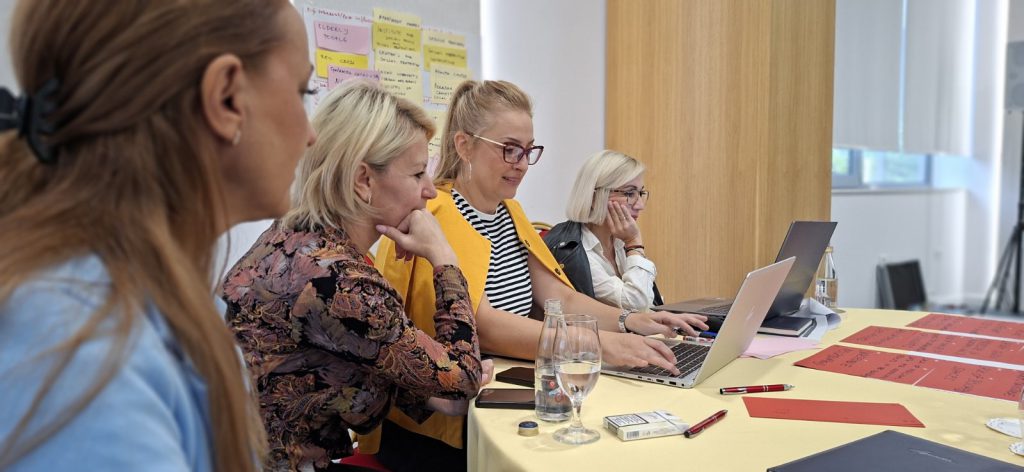

Tirana, 23 September 2026 – How can local governments in the Western Balkans become stronger partners in public administration reform and EU integration? This question was at the centre of the regional conference “Advancing Local Government Reform in the Western Balkans: Towards More Effective and Accountable Governance,” organised in Tirana by the SIGMA Programme, NALAS and the National Association of Municipalities of Albania (NAMA), with the support of the Swiss Development Cooperation.

The conference brought together representatives of central and local governments, local government associations, the EU Delegations in Albania and Montenegro, OECD/SIGMA, the Council of Europe, development partners and experts from the Western Balkans and EU Member States. Discussions focused on four closely connected dimensions of local government reform: multi-level governance and decentralisation, inter-municipal cooperation, administrative supervision and local public finance, alongside the growing role of municipalities in the EU accession process.

Local governments as partners in reform

Opening the conference, speakers stressed that decentralisation is ultimately about enabling municipalities to deliver better services to citizens.

Ritva Heikkinen, Head of Cooperation at the EU Delegation in Albania, thanked SIGMA, NALAS, NAMA and the Swiss Agency for Development and Cooperation for bringing central and local actors together around the multi-level governance agenda. She stressed that local authorities are indispensable partners in the EU accession process, and thatthis requires cooperation across levels of government. She further highlighted the importance of cooperation among municipalities themselves, noting that peer exchange across the Western Balkans can help build capacity and identify practical solutions on the path towards the EU.

Speaking on behalf of Albanian municipalities, Adelina Farrici, Executive Director of NAMA, highlighted that the renewed debate on territorial and administrative reform should go beyond municipal boundaries and address functions, financing, administrative capacity and accessibility of services.

Sabine Piccard, Head of Governance and Health Sectors at the Embassy of Switzerland, emphasised that effective local government depends not only on municipal capacity but also on the quality of relations between levels of government. Responsibilities need to be matched with adequate resources and capacities, particularly as municipalities assume a growing role in implementing national and European priorities.

Kelmend Zajazi, Executive Director of NALAS, emphasized the key role that local governments and their associations have throughout the reform cycle — from policy design and planning to financing, implementation and monitoring. He stressed the principle that “finance follows function”: when responsibilities are decentralised, their costs should be properly assessed and municipalities provided with the resources and capacities required to deliver them. For Timo Ligi, SIGMA Country Manager for Albania, the ultimate benchmark for reform is the quality and accessibility of public services. Institutional arrangements, financing systems and structures matter because they create the conditions for municipalities to deliver better results for citizens.

Making decentralisation work in practice

The regional discussion on local government reform brought together perspectives from Albania, Montenegro, Serbia and the Council of Europe. A recurring message was that formal decentralisation is not enough: functions need to work in practice, with adequate financing, administrative capacity and clear accountability.

Emiriana Sako, Mayor of Durrës and Co-Chair of NAMA, underlined the importance of strengthening the financial dimension of decentralisation. Albania’s experience since the previous territorial reform has shown the value of larger-scale planning and more coordinated municipal investment, while the next stage should further strengthen municipal revenues and better reflect the different fiscal and service-delivery conditions of municipalities.

Nina Blažić, representing the EU Delegation to Montenegro, highlighted how EU accession is providing renewed momentum for local government reform in Montenegro. She pointed to efforts to strengthen central-local dialogue and inter-municipal cooperation, improve performance monitoring and move from administrative control towards supporting municipalities to deliver better services while respecting local autonomy.

Nikola Tarbuk, Secretary General of the Standing Conference of Towns and Municipalities of Serbia, stressed the importance of moving from formal transfers of competences towards a more functional approach to decentralisation, particularly given the large differences in capacity between bigger cities and smaller municipalities.

“Real decentralisation exists only when competences function in practice. That means matching responsibilities with realistic cost assessments, adequate capacities and sufficient financial resources.”

He also highlighted the role of fiscal equalisation, local discretion and inter-municipal cooperation, as well as the importance of local government associations in providing specialised knowledge, training and technical support that smaller municipalities often cannot maintain individually.

Niall Sheerin, Head of the Centre of Expertise for Multilevel Governance of the Council of Europe, emphasised the principle of subsidiarity and the need to adapt local government systems to different demographic, territorial and economic realities rather than search for a single institutional model.

Governance, cooperation and supervision for better services

A dedicated OECD session examined inter-municipal cooperation as a practical response to limited municipal capacity, demographic change and services that increasingly need to be organised beyond individual administrative boundaries.

Sandra Jolk of the OECD Centre for Entrepreneurship, SMEs, Regions and Cities presented international experience showing that cooperation can help municipalities pool expertise, jointly plan investments, improve service quality and achieve economies of scale while preserving local autonomy. Successful cooperation, however, requires clear rules, appropriate institutional arrangements, predictable financing, trust, accountability and performance monitoring.

Monika Kurian from SIGMA presented work on administrative supervision of local governments in the Western Balkans. The analysis showed that supervisory systems often remain strongly legalistic and control-oriented, while preventive guidance and methodological support are less developed. The main message was that supervision should contribute to better governance, rather than simply more control, while safeguarding both legality and local autonomy.

The evolving landscape of Local finances in the EU and Western Balkans

Thomas Prorok, Managing Director of KDZ Centre for Public Administration Research, presented comparative perspectives on local government finance in the EU, including fiscal decentralisation, municipal investment capacity and different approaches to fiscal equalisation.

For Albania, Fran Brahimi, Director of Local Finances at the Ministry of Finance, demonstrated how demographic change is increasingly challenging traditional approaches to municipal financing. Population decline, ageing, rural depopulation and urban concentration are changing both municipal revenue bases and expenditure needs. Even where population falls, the fixed costs of maintaining schools, roads, infrastructure and essential services do not necessarily fall at the same pace.

The discussion pointed towards financing arrangements that increasingly take account of ageing, density, territorial size, service costs, socio-economic conditions and seasonal or tourism pressures, rather than relying predominantly on resident population.

Learning from EU Member States

The panel “How intergovernmental finance systems are evolving in South-East Europe” brought together NAMA, the Albanian Ministry of Interior and experts from Romania and Croatia.

Adelina Farrici presented NAMA’s ongoing local spending review in pre-university education, which is examining the distribution of responsibilities, costs and financing between central and local government and the level of resources required under existing standards.

Radu Comșa highlighted that there is no single European model for organising or financing education. The key lesson from EU Member States is the need to clearly assign responsibilities, identify expenditure drivers, estimate costs and ensure predictable financing where functions are shared.

Dario Runtić, Advisor to the Croatian Minister of Finance and the Association of Croatian Cities, shared Croatia’s experience since EU accession in 2013. He highlighted reforms including the introduction of a new fiscal equalisation system, kindergarten grants, property-tax reforms and partnership councils intended to strengthen intergovernmental dialogue on strategic development and EU funding.

Both Romania’s and Croatia’s experience also showed that EU funds can become a major driver of local capital investment, but need to be accompanied by long-term planning that takes future operating and maintenance costs into account.

Local governments must have a place in the EU accession process

EU integration emerged throughout the conference as a cross-cutting driver of local government reform, financing and capacity development.

Vanessa Bauer, Programme Manager at GIZ, highlighted that municipalities will implement an important share of the reforms and investments stemming from accession. The EU4Municipalities programme, co-funded by the EU and BMZ and implemented by GIZ, NALAS, NAMA and KDZ, will support the policy and regulatory framework and help Albanian municipalities develop the practical capacities required for this process.

The conference concluded with a shared message: strong multi-level governance depends on partnership. Responsibilities and resources need to be aligned; supervision should support performance while respecting autonomy; cooperation should help municipalities achieve scale; and local governments should have a meaningful role in shaping the reforms they will ultimately implement.

For NALAS, which represents around 9,000 local authorities across South-East Europe, advancing this agenda remains central to ensuring that the Western Balkans’ path towards the European Union translates into stronger municipalities, better public services and more effective governance for citizens.